
Start a Cullman County Records Search
A smart Cullman County records search follows a set order. Begin with Cullman Revenue's property search when you hold an address, owner, company name, subdivision, parcel number, account, or PIN. Revenue keeps the assessment and the tax-roll identity. Its PIN or PPIN is your practical link to the map and a stable clue for the recorded trail. Save the exact identifier first. Note the tax year too. Keep the legal description as well. A mailing address can differ from the situs address, and a city label can misstate the jurisdiction. So Cullman County property records line up best when the assessment, mapped tract, and deed all describe the same land.
- Search Revenue by address or name and record the PIN, parcel, account, tax year, and source spelling.
- Open the GIS viewer with that identifier and confirm roads, parcel shape, corporate limits, and map context.
- Search Cullman Probate for the latest deed, then compare grantor, grantee, legal description, and recording citation.
- Check assessment, exemptions, tax status, and any court or probate event relevant to the question.
- Request a copy, older volume, plat, permit, or tax notice from its custodian when the online source stops.
Where Cullman County Records Are Kept
Three county functions split the work in Cullman County. Revenue maintains assessments, tax districts, exemptions, payments, and the parcel identifier. Probate records deeds, mortgages, liens, releases, plats, and other land instruments, while the Circuit Clerk keeps trial-court files that may explain a foreclosure, judgment, quiet-title case, or similar dispute. No single screen combines all three.
Revenue Commissioner
500 2nd Avenue SW, Room 102
Cullman, AL 35055
256-775-4776
Probate Recording Division
500 2nd Avenue SW, Room 101
Cullman, AL 35055
Mail: P.O. Box 970, Cullman, AL 35056
Portals do not hold everything. Phone and counter requests still fill gaps. When Cullman County omits an image or a year online, the Alabama Public Records Law under Code §36-12-40 supports a written request for a specific public record, subject to lawful exceptions and the custodian's process.
Cullman County Revenue Has Seven Modes
The Revenue form centers on a Tax Year field and offers seven modes: Name, PIN, Company, Parcel, Account, Subdivision, and Address. Name mode is the richest. It offers exact Match, Starts With, and Contains choices. A last-name box pairs with an optional first name. The portal publishes no list of accepted tax years, result-card labels, export options, or refresh schedule, so confirm those details when a live search returns.
| Mode | Useful For | Check Next |
|---|---|---|
| Address | A known site | Situs, PIN, and GIS location |
| Name | Parcels indexed under a person | Same-name and deed confirmation |
| Company | Entity-held assessments | Entity record and latest deed |
| PIN | Cross-system match | GIS polygon and legal description |
| Subdivision | Lots in a named project | Addition, phase, lot, and plat |
The separate assessment address search is leaner. It offers Name, PIN, and Address. Neither form promises that a partial street returns the full block, so do not expect a neighbor roster from Cullman County's assessment site.
View Cullman County Property Search
The official Cullman Revenue screen lays out its search entry points.
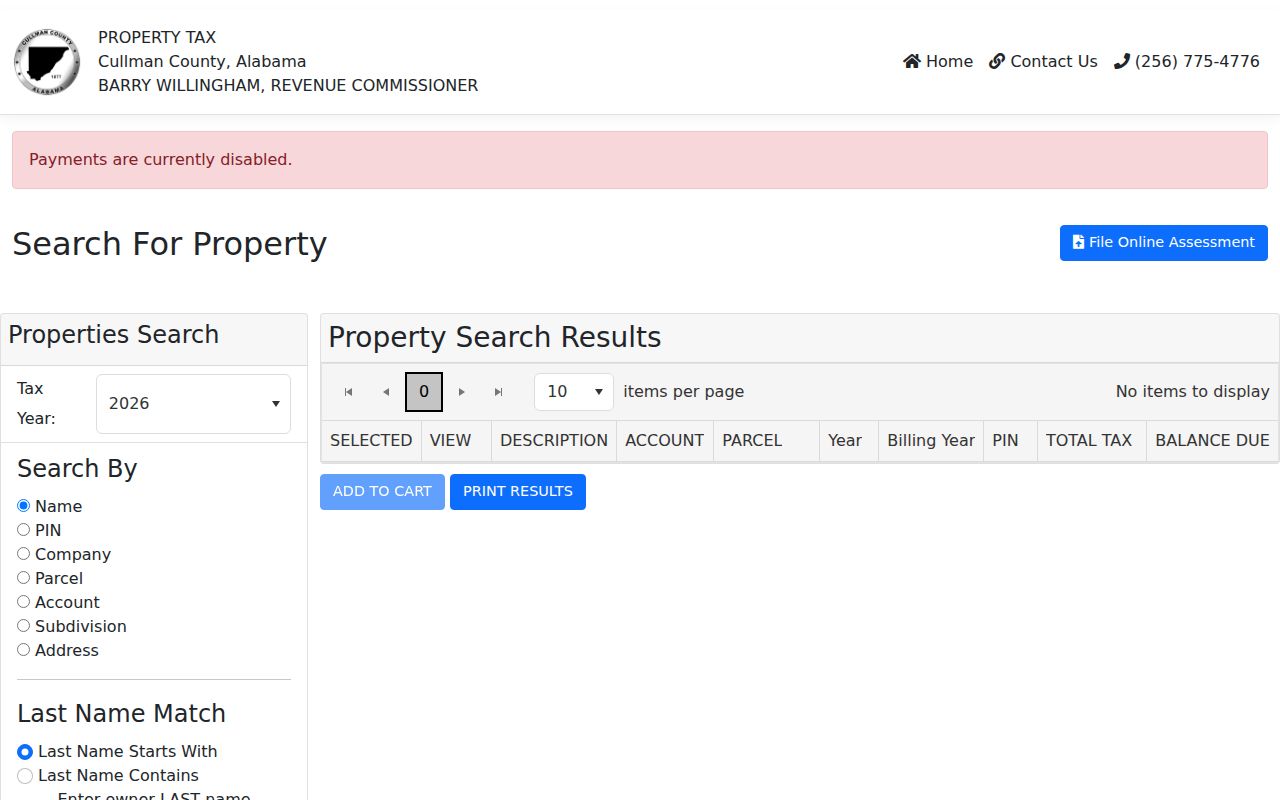
That form documents the available modes, not the contents or update date of a live parcel card. Record only the fields a selected result actually displays.
Map Cullman County Parcels and Districts
The Cullman Revenue GIS viewer adds spatial context. Its service layers include Parcels, Lot Line, Building Footprint, Corporate, City of Cullman Zoning, Flood Zones, Flood Panel, school and voter districts, damage paths, and the County Outline. Identify, find, query, and map export tools sit on top. Open the intended parcel with its PIN. Then compare road names and legal-description clues. Corporate limits help route city permit questions, while flood and zoning layers point toward the controlling records. Lot lines and parcel polygons stay tax-map graphics. They settle no disputed boundary, easement, or title question in Cullman County.
Note: The public viewer's exact buffer, adjacency, selected-card, and refresh controls were not verified in the static research.
The Cullman County Property Record Sets
Each Cullman County record set answers one part of a land question. Match the source to the fact. Expecting the owner list to show a boundary, or a map to prove title, only wastes a search. Pick the record built for the job.
| Record | Fact It Documents | Custodian | Access Route |
|---|---|---|---|
| Assessment and tax roll | Class, assessed value, exemption, tax district | Revenue Commissioner | Portal, office, phone, mail |
| Deed or mortgage | Recorded transfer or encumbrance | Probate Recording | ING portal, counter, request |
| Plat and legal description | Subdivision, lot, block, and recorded layout | Probate, with planning lead | Index, office, planning file |
| Parcel and overlays | Mapped geometry and jurisdiction clues | Revenue GIS | ISV and ArcGIS service |
| Court or probate case | Litigation or estate context | Circuit Clerk or Probate | Just One Look, portal, clerk |
| Permit and zoning file | Municipal land-use or building action | Applicable city | City portal or records request |
A transfer trail needs its own workflow. Use the dedicated Cullman County deed records page, then the Cullman County property search guide for the mechanics of address, owner, and parcel modes.
October 1 Shapes Cullman Records
Alabama assesses property on October 1. The tax on that value is not paid until the following year. That one-year lag shapes every record you will see. Cullman Revenue notes that a buyer who closes late in the year can still receive a new-owner notice. But the original notice went to whoever was the owner of record on October 1. Miss the payment window and the taxes turn delinquent on January 1 after it closes. So a name on the tax bill is a snapshot, not a live title search.
Matching dates matters. Lay the deed's recording date beside the assessment year and the tax notice. Do this before drawing conclusions. A sale, a spouse added or dropped from title, a transfer into a trust, or a life estate with a remainder interest can each matter. Any of these can change the name of record. Treat the tax roll as one dated clue among the deed records. It is not a complete statement of who holds title today.
Note: Cullman's online delinquent-parcel listing is disabled, so current tax-sale research needs an office or published-notice fallback.
Cullman County Deeds Use ING
The ING Records portal handles Cullman land records and Probate case access. It links research-account sign-up with document purchase. The portal states that online land research will require an account beginning August 1, 2026. It publishes no earliest indexed year or image price. Search both grantor and grantee roles. Then preserve the recording date, book and page or instrument number, legal description, and any cross-references. If an online image is absent, try Room 101, a phone or mail inquiry, or a narrow public-record request. eRecording through Simplifile is for submitting, not browsing.
Arab Makes County Checks Essential
Arab is the local geography trap. The municipal profile places Arab in Marshall County. Yet Cullman Revenue lists Arab as tax district 08. A 35016 mailing address or an Arab city permit does not settle which county recorded the deed. Confirm the parcel through Revenue and GIS before relying on either county's land index.
Cullman, Arab, and Hanceville are the county's largest incorporated places by 2020 Census population. Their tallies came to 18,213, 8,461, and 3,217 residents respectively. Those counts explain the city-page set. But population has no bearing on parcel jurisdiction, and tax districts are not a full annexation map.
The Census incorporated-place roster publishes that population ranking.
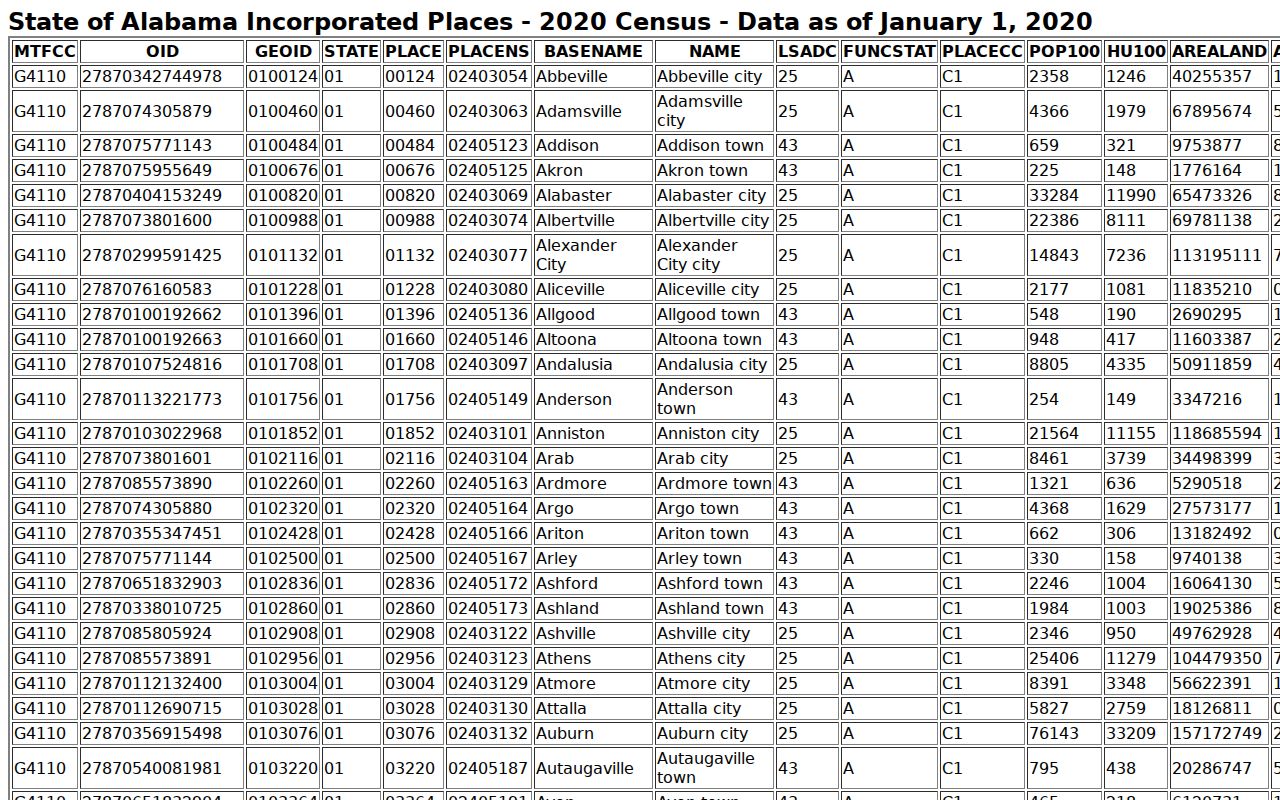
The roster picks the city pages. Parcel jurisdiction still comes down to the county record, the legal description, and the corporate boundary.
Cullman Property Alerts Track Names
The county property-notification form takes a PIN, a name, a phone, and an email. It sends notices when a name changes on a parcel. That can surface an event you did not expect. It can also fire for routine, legitimate transfers. These occur among family, trusts, life estates, and remainder interests. The live county form shows exactly which fields enroll a parcel in the service.
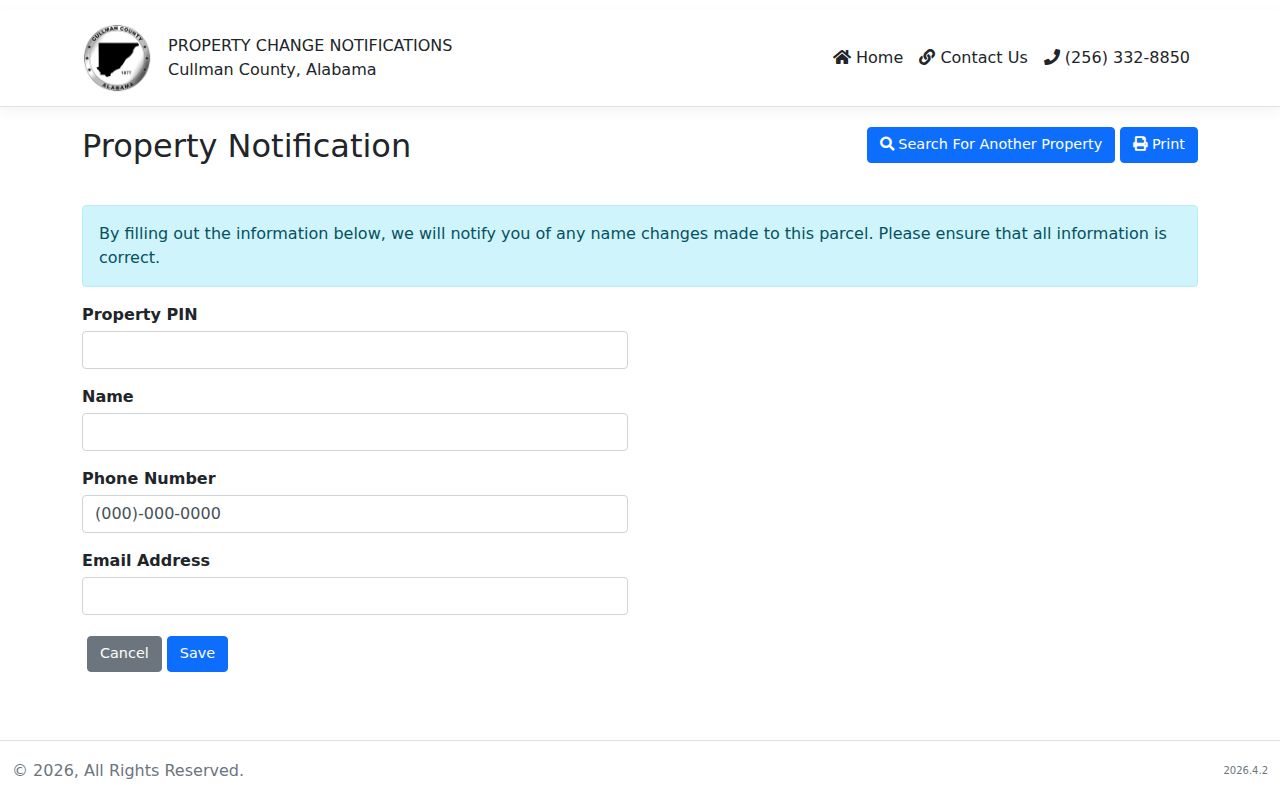
Remember what this form is. It is an alert tool, not a deed search. It cannot stop a transfer. If an alert arrives, respond through official Cullman County channels. Find the recording number and date, then call the published office contact. Treat any payment demand or caller-supplied screenshot with suspicion. An alert neither prevents a filing nor repairs title.
Older Cullman County Property Records
Local reporting from 2018 described electronic preservation work. It covered roughly 50 Cullman County deed books in poor condition. That history explains the patchwork a researcher meets today. An old record may take many forms. It could be an ING image, a courthouse volume, microfilm, or a preservation copy. Ask Probate which book is earliest indexed. Ask whether your range has been digitized. Other Cullman County repositories help fill gaps. The public library offers genealogy resources and computers. It provides scanning and newspaper microfilm that reportedly reaches the 1940s. Alabama Archives holds Cullman city directories for listed years from 1958 to 2002. It also holds German Settlement, railroad, historic-home, and local subject files. A directory entry or newspaper name is only a lead. It is not an owner of record until a deed confirms it.
Cullman Subdivisions Cross Record Types
County commission minutes offer precise clues for finding plats. Union Hill's 11 lots appear there, as do Atwater Landing in Section 31, Grand Vista Pointe's 23 lots off CR 51, a Shady Cove revision, Creekside Estates, Green Tree Estates at Map Book 6 Page 41, and Bella's Ridge Second Addition near CR 616. Minute entries like these sketch a project's chronology. They never replace the recorded final plat. Note the exact addition or phase, lot, block, map book and page, approval date, and recording date. Then tie each lot back to Revenue and the GIS map. Proposed, approved, recorded, permitted, and built are different states. Never merge them.
Cullman Tax Districts Need Context
Revenue assigns eight district codes in Cullman County: 01 County, 02 Cullman, 03 Hanceville, 04 Garden City, 05 Holly Pond, 06 Vinemont, 07 Good Hope, and 08 Arab. A code can hint at which historical millage line or municipal component applies. It does not replace a current corporate boundary, an annexation instrument, or the legal description. Near a city edge, compare the Revenue district against the GIS Corporate layer. Also weigh the applicable city record. Property class and exemptions matter just as much. Alabama assesses Classes I through IV at different percentages. Cullman publishes H1 through H4 homestead paths plus current-use details. The county describes current use for qualifying agricultural, pasture, or timberland. It mentions a five-acre lead, but the application and transfer facts control the outcome. An old millage table covering 2016 through 2019 can illustrate the method. Quoting it as a current rate would be a mistake. Payment channels vary too. Revenue lists courthouse, mail, online, and satellite options. The Baileyton, Dodge City, and Hanceville satellite offices take no cash. The courthouse does. February 28 is the final day for check payment in the delinquent cycle Revenue describes. After that, the accepted methods narrow. Always confirm the current year's instructions before traveling or mailing funds.
Cullman Court Files Explain Land Events
The 32nd Judicial Circuit and Cullman District Court can explain a land trail. That trail includes foreclosure, quiet title, partition, a judgment, or another dispute. The local Circuit Clerk points to statewide Just One Look for much trial material. Search by party, case number, year, and division. Then decide whether the parcel is truly at issue. A named party alone does not make the property part of the case. A worthwhile court review follows the whole event. Read the complaint, any lis pendens, the judgment, the order, any sale or confirmation, the disposition, and a later satisfaction. Then return to Probate for the recorded release, order, foreclosure deed, or other instrument. A docket reports litigation and nothing more. It does not establish current ownership or prove a lien was perfected against the parcel. When no online image appears, ask the Circuit Clerk for a case-number and date-range search. Probate case records may also clarify an executor's authority. They can settle an heirship question, a life estate, or an estate sale. A restricted death certificate is no shortcut around probate. Start with the probate case and the recorded transfer. Use vital records only when eligibility and the transfer question genuinely call for them.
Cullman Access Continues Offline
Convenience has its limits in Cullman County. ING requires an account and charges for document access. Just One Look controls court images. A city permit history sits behind a request even where a landing page exists. The county's current delinquent list is disabled. None of these barriers erases the record itself. The paper trail survives at its custodian.
Build a fallback chain around that custodian. Write down the names, the date range, the parcel or PIN, and the legal description. Note the exact record category before you pick up the phone. Then call or visit the office, or mail a focused request. You can also use the state public-record process. Ask for a cost estimate whenever research or copy fees might apply. A narrow request for a named plat or a recorded citation works far better than asking staff to reconstruct every fact. Staff need not rebuild the whole file about a property.
Historic questions call for a different path. Move from Probate to local library and state archive tools. FamilySearch's Alabama wills and deeds collection can add a name, keyword, place, or film lead. Its coverage of Cullman volumes varies. Alabama Secretary of State land records cover state-government lands, not the county deed index. Label every source by its true scope. That keeps a finding aid from being mistaken for title proof.
Limits of Cullman County Property Records
Cullman County property records carry real weight but only so far. They can show an assessed owner name and a recorded grantee. They can show a legal description, a lien filing, or tax status. A map shape, a court event, or a municipal approval may appear too. They cannot prove a surveyed line. They cannot clear title on their own, or settle a structure's current condition or a market price. Tax-sale certificates and tax deeds do not necessarily convey clear title either. Alabama Revenue recommends a title opinion before relying on them.
Use records with care. Public land information supports purchase diligence, boundary research, tax questions, estate work, and civic review. It must not be used to stalk, harass, target, or harm a person.
Share only what the land question requires. Keep personal details to that minimum. A tax payment is not ownership, and a GIS outline is not a legal survey. A court complaint, likewise, does not establish the final outcome. Verify the relevant record with its custodian. Bring in a licensed surveyor, title company, or Alabama attorney whenever the conclusion carries legal weight.