
How Cullman County Deeds Differ
The Cullman County Probate Office handles deed recording through its Recording Division. That division also accepts mortgages, claims, plats, liens, and releases. Every deed type moves a different interest or grows out of a different event. That is why the form matters. Read the title. Weigh the operative terms of the actual instrument before drawing conclusions from the recorded trail.
| Deed Type | What It Does | Common Use |
|---|---|---|
| Warranty deed | Conveys the stated land with warranties written in the instrument | An ordinary negotiated transfer |
| Quitclaim deed | Transfers the grantor's stated interest without broad title warranties | Family, trust, or title-cleanup work |
| Executor or administrator deed | Conveys through authority tied to an estate | A probate-related sale or transfer |
| Foreclosure or sheriff's deed | Records a transfer after the cited legal process | A sale following court or mortgage action |
| Tax deed | Documents the interest issued through a tax-sale process | State or local delinquent-tax trail |
Not everything indexed beside Cullman County deed records works like a deed. A mortgage, lien, easement, or satisfaction plays a different role in the land record. It sits in the same book range, though. Follow the cross-references. A release can reshape what an earlier mortgage meant. A recorded plat can pin down the exact lot a deed only names in passing.
Cullman Probate Keeps the Trail
The Cullman Probate Recording Division serves as the county recorder for deeds, mortgages, liens, and related land instruments. Its counter is open to the public in Room 101 at 500 2nd Avenue SW, Cullman. Mail goes to P.O. Box 970, Cullman, Alabama 35056. Alabama keeps this land trail in Probate rather than with a separate county clerk. The official recording page is the public route to the division. It also opens the division's online land-record services.
Confirm the custodian first. Knowing that Probate holds the instruments saves a wasted trip to another office. Open the vendor index or call Room 101 after that. The Circuit Clerk belongs in the picture only when a court case might explain the event behind a filing. Think of a foreclosure, a judgment, or a quiet-title dispute. A docket can point toward an order or a recorded document. It never replaces the recorded instrument itself. The Revenue office, in turn, keeps assessment and tax records as a separate system.
Cullman County Probate Recording
500 2nd Avenue SW, Room 101
Cullman, AL 35055
Mail: P.O. Box 970, Cullman, AL 35056
ING Access for Cullman Deed Records
Deed research in Cullman County runs through the ING Records public portal. It pairs land records with Probate case files in one place. The Cullman page covers land-record searching, research accounts, and document purchase. It also notes an upcoming change. An account will be required for online land-record research beginning August 1, 2026. Anyone tracing a parcel number or deed back through Cullman County records can start at the official entry point. This Cullman Probate portal landing page opens the county index directly.
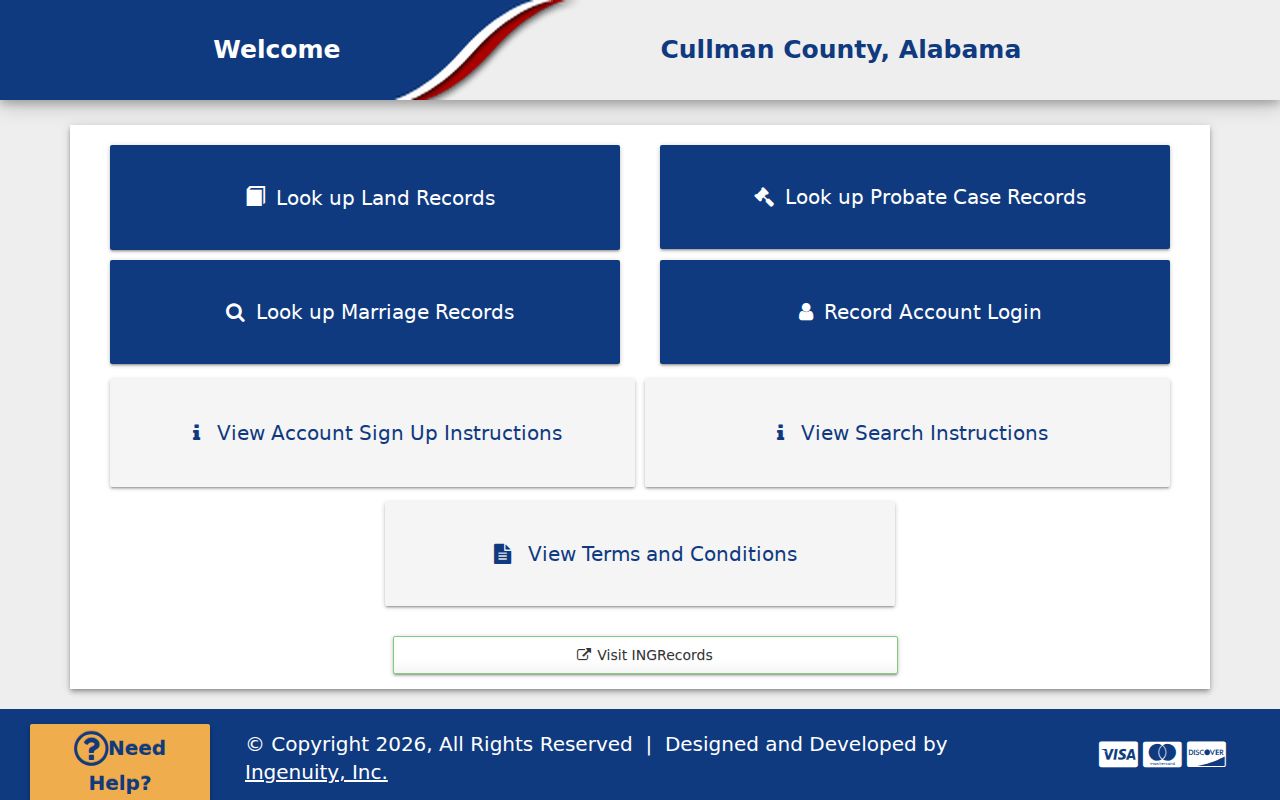
The Cullman Probate portal landing page is the official gateway to the county index. It separates Probate case records from land records. That split matters. An estate file can explain a transfer, but only the recorded deed carries it. The static landing page does not list the current instrument types, the earliest online year, or the cost of a deed image. Do not fill those gaps with another county's portal. Search what the live Cullman controls actually show. Record the citation for any result. When a year or volume seems missing, ask the Recording staff directly. The official recording login is the account entry point for online research.
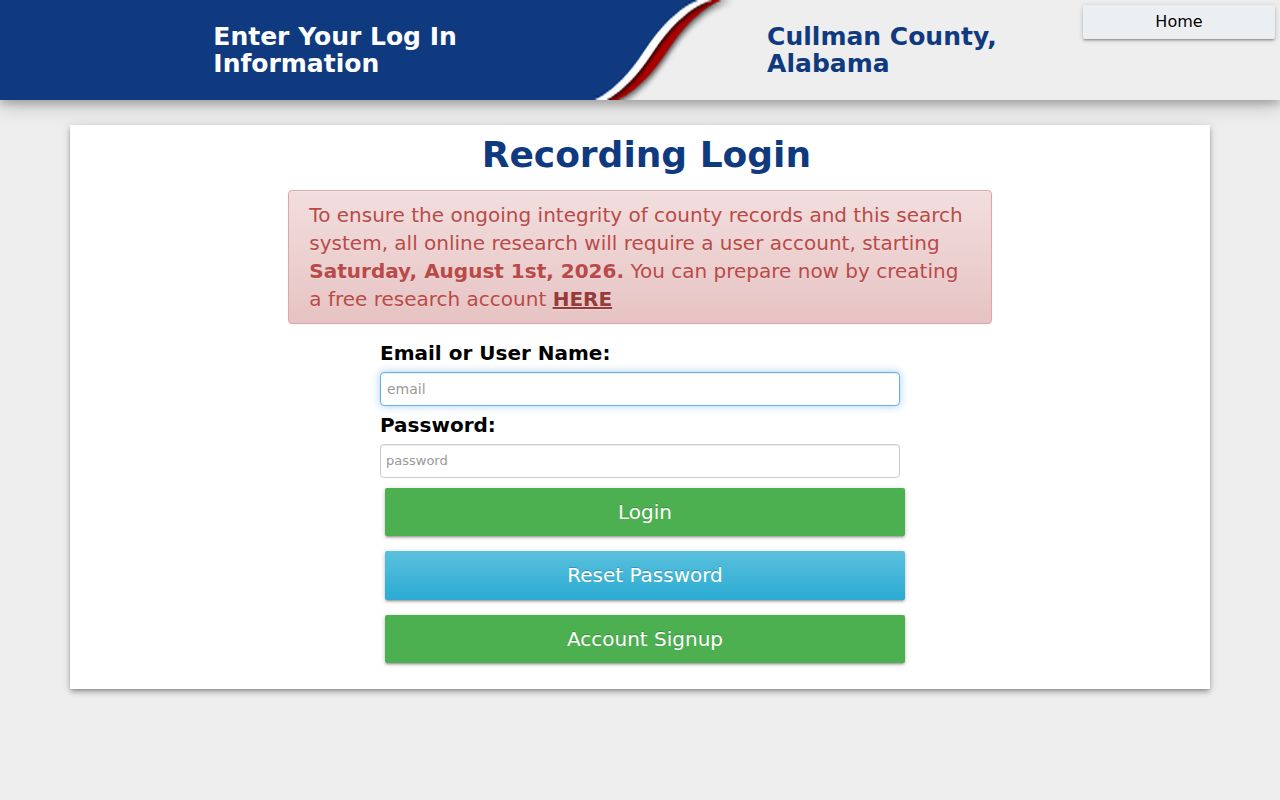
The login screen is only the gate. It establishes access, not coverage, result counts, or the price of a deed image.
Fields Behind a Cullman Deed Search
The vendor's instructions describe how the public land-record service works, but Cullman's own live portal governs any final choice of search. The service supports name and date searching, grantor, grantee, and assignee roles, a Starts With option, book and page, instrument number, and cross-reference review. Let the actual Cullman screen dictate your terms.
| Search Clue | Use in the Deed Trail | Limit |
|---|---|---|
| Grantor | Find transfers out of a known owner | Name variants can split results |
| Grantee | Find the deed by which an owner acquired land | Same names require description checks |
| Date range | Narrow a known transfer window | Execution and recording dates can differ |
| Book / page | Retrieve a cited recorded document | Keep the series or book type |
| Instrument number | Open a specific modern citation | Copy every digit exactly |
| Cross-reference | Follow a correction, release, or linked filing | One document may not close the chain |
Vendor material notes that an unchecked Starts With control may behave like a contains search, but test that behavior in Cullman before counting on it. It also describes results sorted by file date and tools for buying images. Treat both as mechanics to verify, not facts about local coverage.
Follow Cullman's Grantor-Grantee Index
A chain of title is the ordered run of instruments that transferred the same piece of land. Start with the most recent deed. Work backward through names and legal descriptions. Names alone will not carry the trail, because a seller may hold several tracts and a subdivision can carry additions or revisions with nearly identical labels.
- Find the current acquisition deed by searching the present name as grantee and comparing the legal description.
- Record grantor, grantee, deed type, execution and recording dates, consideration, book and page or instrument number.
- Search that grantor as an earlier grantee. Compare the same lot, block, section, tract, reservations, and cross-references.
- Repeat until the online index stops, a description changes, or an estate, trust, plat revision, or court event needs separate work.
- Ask Probate for the older deed book, image, microfilm, or office-only index needed to keep the chain moving.
- Grantor
- The party transferring the stated interest.
- Grantee
- The party receiving that interest.
- Chain of title
- The linked sequence of instruments for the same land.
- Book and page
- A volume-and-page recording citation.
- Instrument number
- A distinct number assigned to a recorded filing.
When the legal description shifts, find out why. A lot split, added phase, road vacation, corrective deed, or new survey can break a simple parcel-number trail. County minutes can lead you to a final plat, but they never substitute for the recorded plat itself.
Legal Descriptions Anchor Cullman Deeds
A mailing address helps you find a parcel. But the legal description anchors the deed trail in Cullman County. Records here can rely on lot, block, subdivision, and map-book references. They may also use section, township, and range. Some turn to metes and bounds instead. Atwater Landing minutes, for instance, cite Section 31, T12S, R5W as a project clue. Other minutes point to roads and subdivision names. Preserve every element of the description. Keep the full addition or phase together. Include the lot and block, map book and page, and recording date. Road descriptions like "off CR 51" or "west of an address on CR 616" are discovery clues. They are not legal descriptions. When a lot or subdivision is involved, compare the deed against the final recorded plat before you trust the match.
Note: A PIN helps join modern systems, but a changed parcel identifier does not erase the recorded legal-description trail.
Fees on Cullman Recorded Instruments
The county's recording information sheet lists a deed first-page fee of $4.50 and $2.50 for each added page. Deed tax adds $1 per $1,000. It also identifies extra-name and cross-reference charges. Possible real-estate validation requirements may apply. Mortgage tax runs $1.50 per $1,000. Confirm the current schedule and document-specific local charges before submitting anything.
Those figures cover recording only. Image purchase through ING may carry its own Cullman County price. Ask whether the product is an uncertified image, a plain paper copy, or a certified copy. Get a total first.
Older Cullman Deed Books Survive
Local preservation reporting in 2018 described roughly 50 Cullman deed books in poor condition, selected for electronic preservation through county action and an archives grant. That effort is worth asking about. Was a particular book scanned? Where does the master image live? Does the public portal expose it? Preservation is not proof that every old volume sits online.
The earliest Cullman deed-book date and any online cutoff are not published, so Probate remains the first stop for an older volume. The Cullman County Public Library adds genealogy tools, scanners, and newspaper microfilm, while Alabama Archives holds city directories and Cullman subject files. Those aids can track down an old name or place. But only Cullman County deed records establish the instrument trail behind a parcel.
Cullman Title Alerts Flag Name Changes
The Revenue property-notification service takes a PIN, name, phone, and email. It then sends alerts tied to property-name changes. Not every alert signals trouble. Legitimate sales, family additions or deletions, life estates, remainder interests, and trusts can all trigger one. Treat an alert as a cue to inspect the recording, not as proof of fraud.
If an unexpected alert arrives, go to official county sources. Record the new instrument number and date. Inspect the deed, and call the published office number. The notification service cannot block a transfer, correct an instrument, or replace legal help.
Obtain a Cullman County Deed Copy
Start with the ING image or citation when the record is available online. For records outside online coverage, contact Recording staff with the grantor, grantee, and approximate date. Include the deed type, book and page or instrument number, and legal description. A narrow request is easier to price and retrieve than an open-ended name search.
Access is not limited to one portal. A researcher can use the online index. That researcher can also visit Room 101, ask questions by phone, or mail a written request. Alabama's public-record process supports a focused request for an identifiable public writing. Authorized submitters may also file through Simplifile eRecording. That route is for submission, not a public deed search.
Recorded, not guaranteed. Cullman County deed records show what reached the recording office. They do not rule out an unrecorded interest, settle document validity, establish lien priority, or provide a title opinion.
Specify whether the copy must be certified. Say how you want it delivered. Retain the receipt, the certification, and the exact citation with your research file. A title company or Alabama attorney should evaluate clear title, competing interests, and the legal effect of the instrument.