
Cullman Property Value Types
Before comparing any Cullman County property records figure, know which number you hold. Revenue handles appraisal and assessment for tax purposes. The Probate office records deeds. A deed may list the purchase price or the real-property value stated at transfer. A licensed appraisal is a different animal. It is a dated opinion from a professional and sits outside the public tax portal.
| Value | What It Is | Where |
|---|---|---|
| Appraised value | County appraisal before the class ratio | Revenue assessment |
| Assessed value | Appraised value multiplied by the property class percentage | Revenue assessment |
| Sale consideration | Amount or value stated for a recorded transfer | Probate deed trail |
| Market appraisal | A date-specific professional opinion for a stated purpose | Independent licensed appraiser |
Do not expect assessed value to match appraised value. Alabama applies a class percentage, so the assessed figure lands lower by design, and the gap is not a loss in worth. Deed records can diverge too. A sale between family members, or a transfer through a trust, an estate, or a life estate, may carry consideration far from an open-market price.
Cullman Assessed Value by Class
Cullman County uses four class percentages. Class I covers utility property at 30 percent. Class II, which holds most other property, sits at 20 percent. Class III, covering agricultural and owner-occupied residential land, is 10 percent, and Class IV private passenger vehicles run at 15 percent. Most real-estate work involves Classes II and III.
The math is simple. Appraised value times the class percentage yields assessed value, while millage and exemptions come later in the tax-bill calculation. Comparing a Class II parcel with an owner-occupied Class III home on assessed figures alone misleads, since the ratios differ by law.
- Appraised value
- The county's estimate before applying the class percentage.
- Assessed value
- The value after the Alabama class percentage is applied.
- Assessment ratio
- The class percentage that converts appraised value into assessed value.
- Reappraisal
- The county's recurring review of property characteristics and value.
Cullman Value Follows Tax Year
Alabama sets its property lien and assessment date on October 1. Taxes are then paid one year in arrears. The state DOR calls for annual reappraisal of one-quarter of each county. That produces a full four-year review cycle. Compare values drawn from the same tax year. Do that before judging one higher or lower.
Timing explains many puzzles for new owners. A deed recorded after October 1 may not line up right away. It may not match the owner of record on that assessment snapshot. Improvements can also show up after a field review rather than when construction ends. Note the assessment year. Note the deed date and any improvement date you can see on the parcel.
Note: A recent transfer and the current assessment may describe different points in the property's record timeline.
Compare Cullman Property Value Records
Two search forms cover Cullman County value records. The Cullman assessment search works by Name, PIN, or Address. A separate property-search form adds Company, Parcel, and Account. It also includes Subdivision modes. It also includes a Tax Year control. That single control lets you compare a parcel's value across years without starting over.
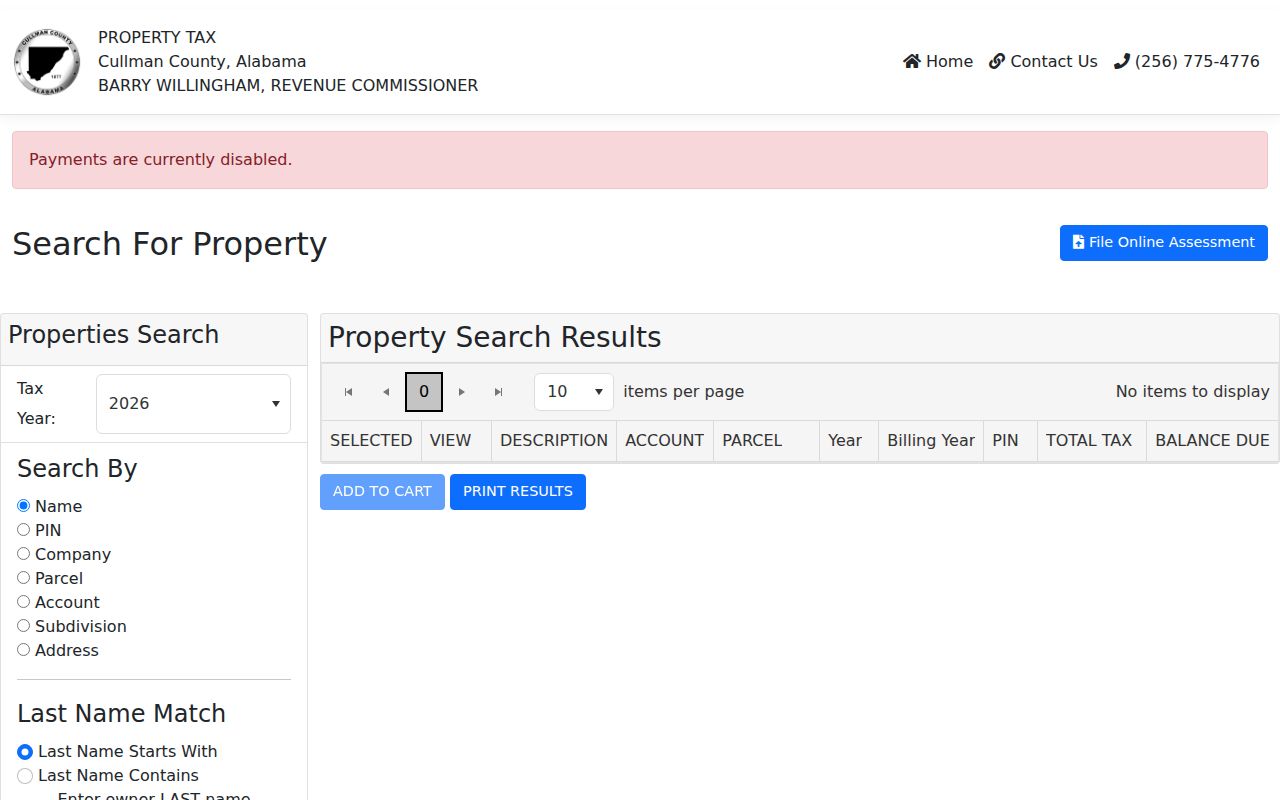
Pick the route that fits the clue you already have. Whatever the entry point, confirm the parcel identity before reading any value tied to it.
- Search the address, then confirm the parcel with its PIN, road, and legal-description clues.
- Record the tax year, appraised figure, assessed figure, class, and any exemption or current-use treatment shown.
- Calculate the class relationship and check that unlike years or classes are not being compared.
- Use the latest relevant recorded deed to inspect stated consideration and transfer terms.
- Seek a current appraisal when the question is likely sale value rather than tax-roll value.
Cullman Exemptions Shift Taxable Value
Cullman County's H1 through H4 homestead paths carry different eligibility and renewal rules. An exemption shrinks the tax base, not the property. The home, land, and recorded deed amount stay the same. So the pre-exemption value and the figure used in final tax math are two different numbers. Treating them as one leads taxpayers astray.
Current-use treatment creates a similar gap. Qualifying farm, pasture, or timberland generally needs five acres and productive use. Application is due by December 31. A transfer or name change can trigger a new application. If the classification ends, the assessed base may climb even though the tract itself never changed.
Cullman Districts Affect Tax Math
Cullman Revenue assigns district codes 01 through 08. Municipal entries include Cullman, Hanceville, and Arab. District drives millage once the assessed value is set. It never changes what appraised or assessed value means. Keep the valuation record separate from the bill math that follows it.
A county table covering 2016 through 2019 shows rates from 26 county mills up to 38.5 in certain Cullman and Arab districts. That table is historical only. Ask Revenue for the current rate tied to your parcel and year. Arab also crosses county lines. Confirm county and corporate jurisdiction rather than trusting the mailing city.
Cullman Sale Value in Deeds
Alabama expects deeds to state a purchase price or real-property value. This applies at recording in Cullman County. When a deed leaves that figure out, a real-estate validation form under Code 40-22-1 can step in. The deed tax owed at filing is its own matter. It has no link to the assessment. A stated consideration should never be read as a current market estimate.
Treat a deed as one piece of a larger picture. Read the deed type, the parties, and the recording date. Read the legal description and the stated value together. Nominal or non-market transfers can diverge from a tax appraisal for good reason. For recorded deed records, Probate is the office to consult; for the tax-year valuation, Revenue.
Cullman GIS Adds Value Context
The Cullman Revenue GIS layers parcels, building footprints, corporate limits, City of Cullman zoning, and flood zones and panels onto one map. That context helps. A footprint shows roughly where improvements sit. A zoning layer flags city rules, and a flood panel points to the controlling map. None of it prices the property.
Treat the map as a starting frame, not an answer. Footprints run stale. Flood overlays do not decide elevation or insurance questions. City zoning stops at the city line. After GIS frames the question, confirm characteristics through Revenue records, permits, official maps, or an appraisal inspection.
Cullman Assessed Value Limits
An assessed value in Cullman County exists for tax administration, nothing else. It is not a price a buyer must pay. A lender will not accept it. A licensed appraiser working to a stated effective date will reach an independent conclusion, and even the county's appraised figure reflects its own assessment process and tax year rather than the open market.
Tax sales invite a second mistake. Alabama DOR cautions that a state-held tax certificate or tax deed does not by itself deliver clear title, and a tax amount someone paid says nothing about property value. Keep four questions separate: tax status, title quality, the assessment, and market appraisal.
Value is not price. Cullman assessed value is for taxation, not a sale appraisal or a promise of present market proceeds.
Cullman Value Records Offline
When the portals do not surface an older assessment, or when a needed detail is missing, Revenue offers several channels. You can visit the courthouse, use a satellite office, call, mail a request, or file a public-record request. The main office sits in Room 102 at 500 2nd Avenue SW, Cullman, phone 256-775-4776. Satellite offices in Baileyton, Dodge City, and Hanceville handle supported county services.
Write requests narrowly. Give the PIN and the legal description. Add the tax year and the exact value field you need. Alabama Code section 36-12-40 supports resident inspection and copying of public writings. That right holds unless an exception applies. For the recorded sale itself, ask the Probate Recording Division in Room 101. Revenue cannot reconstruct a deed.