
Identify Who Owns a Cullman County Property in Four Moves
Cullman County splits the ownership trail across three offices. Revenue, GIS, and Probate each hold a piece. The reliable method turns a street address into a PIN or parcel number, reads the tax-roll name, and checks that the map points to the right land. Then it follows the trail to the newest deed. Keep the PIN and legal description beside the owner name. Those details stop a same-name match or mailing-address mismatch from becoming a false answer.
- Enter the address in the Revenue Commissioner's assessment search and copy the PIN, parcel number and returned owner name.
- Open the county GIS, locate the same PIN and check the parcel shape, road position and corporate-area context.
- Trace the named owner to the newest acquisition deed in the Cullman County Probate land-record index.
- Match the deed's grantee and legal description to the tax and map records before treating the name as confirmed.
This sequence separates the recorded owner from a tax-notice recipient, an occupant, or a neighboring lot. Names alone can mislead. A freshly recorded deed sets one trap. The Revenue name may lag behind the transfer, so the document date and the recording date both matter.
Trace a Cullman County Address to Its PIN
The separate Revenue assessment search accepts Name, PIN, or Address routes. An address is only the starting clue. Copy the PIN from the matching record. That number joins the property search and GIS. The public search also exposes Name, Company, Parcel, Account, and Subdivision modes, which help when the street form fails.
Road names, county road numbers, and directional forms vary across Cullman County. An exact address can miss. Strip the query to the stable road name, or search by the owner's name instead. You can also check the map. A street-only query may not list the block. The Cullman assessment search is the public entry point. It turns an address into a county record. Treat its results as a first step, not the last.
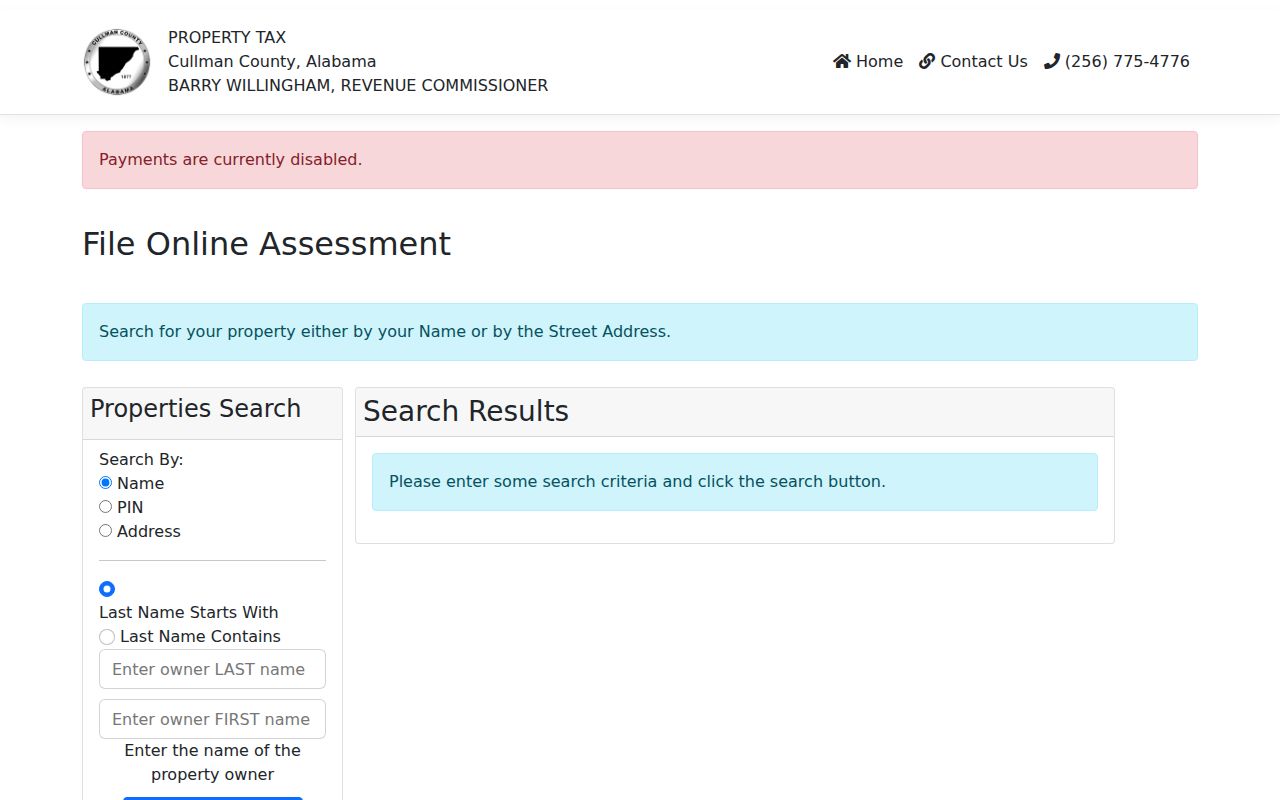
Treat the first name match as a lead, not the full answer. The returned identifier is the bridge to GIS and Probate, where the map and the deed records either confirm the name or point somewhere better.
Read the Cullman County Owner Name as a Tax Snapshot
The Revenue Commissioner keeps assessment and tax records, not the recorded title archive. Alabama property is assessed as of October 1 and tax is paid in arrears. Cullman County's new-owner notice explains why a later buyer may receive a notice even though the first notice went to the October 1 owner of record. That timing can make a valid Revenue result look older than a just-recorded deed.
| Ownership clue | What it answers | Best next check |
|---|---|---|
| Revenue owner name | Who appears on the assessment snapshot | Match PIN and tax year |
| GIS parcel | Which mapped polygon the PIN identifies | Compare the legal description |
| Latest Probate deed | Who received the recorded interest | Read grantee, date and description |
| Court or probate case | Why a transfer or dispute occurred | Find the resulting recorded instrument |
Sources That Identify a Cullman County Property Owner
No single screen proves every part of ownership. Revenue gives the fastest name lead. GIS fixes that lead to a place, Probate records the instrument, and a state entity search can clarify a business name. Use the least personal data needed, and keep the source dates.
| County source | Ownership clue supplied | How to reach it |
|---|---|---|
| Revenue property search | Tax-roll owner lead tied to PIN or parcel | Online by name, address, company, PIN and other modes |
| Probate land-record index | Grantee and grantor on the recorded transfer | ING Records account or Recording Division |
| Alabama business records | Entity record for an LLC or corporation | Secretary of State online search |
| Revenue GIS | Parcel geometry and map overlays | Interactive ISV viewer |
An owner of record is not an occupant. That gap trips up many searches. A property may sit vacant, carry a life estate, or be held by an entity. Its owner may even be mailed elsewhere. Cullman County's notice materials also count trust transfers, added spouses, life estates, and remainder interests as ownership changes. Those situations call for reading the deed, not guessing from a name.
Trace the Cullman County Result to the Newest Deed
The Cullman Probate public portal is the recorded-instrument route for deed records. Search the Revenue name as a grantee. Set a sensible date range. Then compare book, page, or instrument details against the parcel's legal description. The portal requires a user account for online land-record research beginning August 1, 2026. Image access may involve a document purchase. The portal publishes no index-back year. So treat it as current, not complete. When a name, instrument, or image is missing online, contact the Recording Division in Room 101 at 500 2nd Avenue SW. A focused written request to P.O. Box 970, Cullman, AL 35056 works as well.
Identify a Cullman County LLC, Trust or Estate Owner
A company name from Revenue deserves a second look. Search the exact entity in the Alabama Secretary of State Business Entity Records. You can search by entity name or number. Officer, agent, and incorporator fields can distinguish similarly named entities. That filing rarely names the land itself. It does not replace the deed. Nor does it prove that any listed person owns the property personally.
- Owner of record
- The person or entity shown by the relevant public record at that record's date.
- Vesting
- The wording that states how the grantee receives and holds the interest.
- Grantee
- The person or entity receiving the interest in a deed.
- Situs address
- The physical property location, which may differ from an owner's mailing address.
An estate or trust trail can need two threads. One is the Probate case. The other is the deed recorded by the Recording Division. Search the decedent, estate, representative, trustee, and later grantee, then join them by legal description and cross-reference rather than surname alone.
Resolve Cullman County City Lines Before Naming the Owner
City names do not settle ownership questions. A mailing address can sit inside one county while the parcel belongs to another. Cullman Revenue treats Cullman, Hanceville, and Arab as county tax districts. Arab shows the problem best. Its city profile ties to Marshall County, yet Cullman Revenue taxes it under district 08. Before naming an owner for any Arab address, pin down the county. Then confirm which county actually holds the parcel and deed records.
The GIS Corporate layer and a tax district code are helpful context. They are never proof of title. A single ZIP can straddle a city or even a county line. Treat the county, the PIN, and the legal description as one package. Include the newest Cullman County deed records in that package. That same caution explains why a city permit file describes a building project. Yet it says nothing firm about the current owner of record.
Cullman County Name-Change Alerts Add a Timely Check
Owners can also keep watch on their own parcel. The Revenue Commissioner offers a Property Notification form where an owner registers a PIN, name, phone, and email for alerts about name changes. Legitimate events can trigger a notice. A sale qualifies, and so do family transfers, trust changes, and life-estate or remainder adjustments. The service works as a warning system, nothing more. It is not an ownership certificate.
After someone finds who owns a property, this tool helps them monitor their own parcel for an unexpected change. A notice should send you back to Revenue and the Probate deed index. The alert itself never describes the full legal interest.
Limits of Asking Who Owns This Property in Cullman County
A public owner search has firm limits. It cannot show who lives at an address. It also cannot confirm that every interest has been cleared, or prove a mapped line equals a surveyed boundary. Court dockets may explain a foreclosure, a quiet-title fight, or an estate case. But the docket never substitutes for the deed recorded against the land. Paying the tax bill or holding a tax-sale certificate does not, on its own, establish clear title either.
Use ownership data with care. Cullman County records support lawful property diligence and civic research. Never use an owner name or address to target, intimidate or harm a person.
Some situations call for a professional. A purchase, a boundary conflict, an easement question, or a complex estate can hide interests and exceptions that a quick search misses. Use the public route to identify the likely owner of record and to assemble the right property records, then let a title professional interpret them.